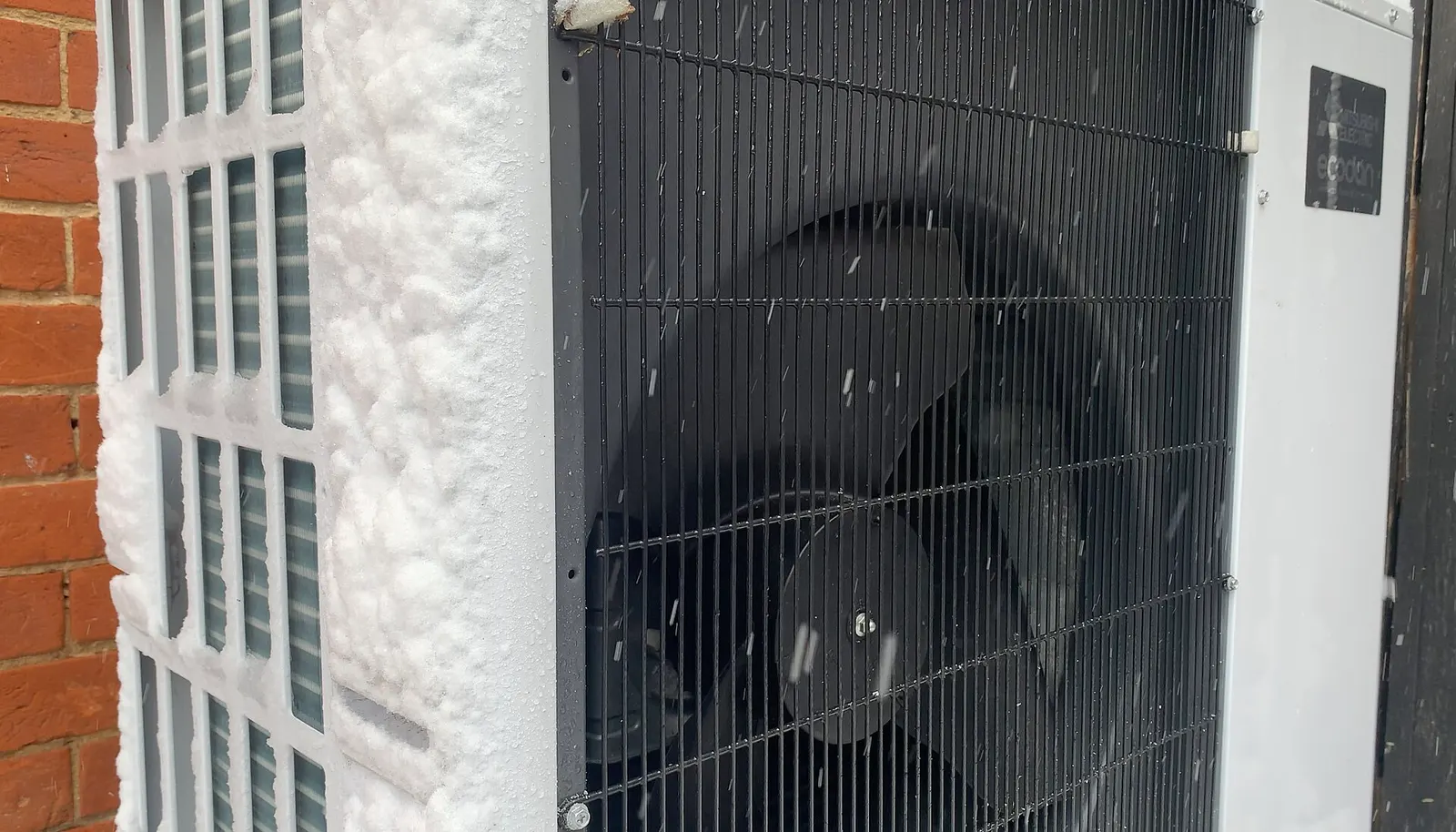
Photo: PeterEastern, Wikimedia Commons, CC BY-SA 4.0. Not located in PEI. Media details
Section A
What makes a heat pump different?
Electric resistance heating
Converts electrical energy directly into thermal energy, as current flows through a heating element.
Fuel-burning furnace or boiler
Releases heat by burning a fuel such as heating oil or natural gas. Some energy is always lost, so efficiency stays below 100%.
Heat pump
Uses electricity to transfer existing thermal energy from a colder place to a warmer one, rather than creating all of the heat.
Heat naturally flows from warmer to colder places. Natural Resources Canada compares a heat pump to cycling uphill: it uses electrical energy to move heat “against” its natural direction. None of these systems is automatically the cheapest everywhere; costs depend on local energy prices, equipment and the building. [17]
Section B
How a heat pump works
An air-source heat pump circulates a refrigerant through a closed loop. The refrigerant alternately absorbs heat (in the evaporator), is compressed (in the compressor), releases heat (in the condenser), and has its pressure lowered (in the expansion device). A reversing valve switches the direction of refrigerant flow so the same equipment can heat or cool. Designs vary: ground-source, ducted and ductless systems use the same principle with different components. [17]
Heating mode / Cooling mode
Switch modes to see how the direction of heat transfer changes. Gold arrows show net heat transfer; the dashed loop shows refrigerant flow.
Heating mode: moving heat into the building
- Liquid refrigerant passes through the expansion device, which lowers its pressure and temperature.
- At the outdoor coil, acting as the evaporator, the cold refrigerant absorbs heat from outdoor air and boils into a low-temperature vapour.
- The compressor, powered by electricity, squeezes the vapour, raising its temperature.
- The reversing valve sends the hot vapour to the indoor coil, acting as the condenser. It releases heat into the building and condenses back to a liquid.
- The liquid returns to the expansion device and the cycle repeats.
Refrigerant circulates around the loop in both modes. What changes is which coil absorbs heat and which releases it, and therefore the direction of net heat transfer. [17]
Section C
Understanding heat pump efficiency
COP = useful thermal energy delivered ÷ electrical energy consumed
The coefficient of performance (COP) compares heat delivered with electricity used under specific conditions. In a simple hypothetical example, a heat pump delivering 3 kWh of heat using 1 kWh of electricity has a heating COP of 3. This does not violate conservation of energy: the additional 2 kWh is thermal energy transferred from the outdoor environment. [17]
Simplified efficiency comparison
Each system receives 1 kWh of electricity. Adjust the hypothetical heat pump COP to see how much heat it would deliver.
- From electricity
- Transferred from the outdoor environment
Resistance heater: 1 kWh electricity → about 1 kWh heat. Heat pump at COP 3.0: 1 kWh electricity + 2.0 kWh moved from outdoors → 3.0 kWh heat delivered.
Simplified point-of-use illustration, not a universal comparison. Natural Resources Canada reports air-source COPs typically between 2.0 and 5.4 at 8 °C, falling to between 1.1 and 3.7 at −8 °C. Actual performance depends on the equipment and conditions. [17]
Steady-state versus seasonal performance. COP is measured at a fixed set of temperatures. Seasonal metrics, such as the heating seasonal performance factor (HSPF), estimate performance across a whole heating season. Laboratory-point COP should not be treated as actual whole-season performance. [17]
Section D
Do heat pumps work in Canadian winters?
Yes, with the right equipment and planning. Even cold air contains useful thermal energy: Natural Resources Canada notes that air at −18 °C still holds 85% of the heat contained in air at 21 °C. [17]
- Temperature difference
- The colder it is outside, the harder a heat pump works to move heat indoors, so efficiency and capacity fall.
- Cold-climate designs
- Cold-climate air-source heat pumps are adapted to Canadian conditions; some can operate well below freezing, down to about −30 °C. Many other models have minimum operating temperatures between −15 °C and −25 °C. Limits depend on the specific model. [18][17]
- Defrost operation
- Near or below freezing, frost forms on the outdoor coil. The unit periodically reverses to melt it, which temporarily reduces heating.
- Sizing and insulation
- Correct sizing by a qualified professional matters. Reducing air leakage and improving insulation first can allow a smaller, more efficient system.
- Supplementary heat
- Below a home’s balance point, or the unit’s minimum temperature, supplementary heat—electric resistance or a furnace in a hybrid system—may be needed.
Section E
Heat pumps in Prince Edward Island
Heat pumps are central to building electrification: replacing fuel-burning space heating with efficient electric equipment, ideally alongside efficiency improvements that reduce how much heat a building needs.
Government of PEI · published June 30, 2026
About 45,000 heat pumps since 2018
According to the Government of Prince Edward Island, the province and the Government of Canada have invested $95 million since 2018 to install 45,000 heat pumps. [22]
The free heat pump programs were closed to new applications, and the relevant residential heat pump rebates ended on April 15, 2026. These are not presented here as available incentives. Program availability can change; check directly with the Government of Prince Edward Island before making any decision.
Section F
Environmental benefits and limitations
Benefits
- Efficient heating in winter and cooling in summer from one system.
- No greenhouse gas emissions from combustion in the home while heating. [18]
- Can reduce fossil-fuel use when replacing oil or gas heating.
- Potential emissions reductions, depending on how the electricity is generated.
Limitations
- Higher upfront equipment and installation costs than some systems. [17]
- Needs correct sizing and qualified installation; performance drops in very cold weather.
- Refrigerants must be handled carefully: leaks reduce performance, and many refrigerants can contribute to climate change if released.
- Requires regular maintenance, such as cleaning or replacing filters.
- Indirect emissions depend on the electricity supply.
- Compatibility with existing ducts, radiators, insulation and electrical service varies.
Operating costs depend on local electricity and fuel prices, the equipment, the building and the climate. No universal savings are promised here. [17]
Knowledge check
Test your understanding of heat pumps
Next learning step
Where would you like to go next?
Want to explore further?
Watch the Science in Action
Optional videos from public science agencies. Everything you need is in the written lesson above. Videos open on the publisher’s own site, so this page loads no third-party players or trackers.
Natural Resources Canada
Real Canadian installations and interviews · 4:19
An introduction to cold climate heat pumps
Part of NRCan’s heat pump retrofit series, featuring Canadian contractors and homeowners discussing cold-climate heat pumps.
What to look for: Listen for how cold-climate models keep working at low outdoor temperatures, and when backup heat is still needed.
Takeaway: A heat pump moves heat rather than making it, so it can deliver more heat energy than the electricity it uses. That advantage shrinks as outdoor air gets colder.
Hosted on YouTube by NRCan. Caption availability is controlled by YouTube and has not been independently confirmed.
Video credits and access notes: Media credits
Sources & further reading
- [17] Natural Resources Canada. Heating and Cooling with a Heat Pump (opens in a new tab) (Not dated).
- [18] Natural Resources Canada. Heat Pump Basics (opens in a new tab) (Not dated).
- [22] Government of Prince Edward Island. Heat Pumps (opens in a new tab) (June 30, 2026).